FIFA U17 Women's World Cup
Black Maidens to begin seventh World Cup campaign against Norway on Sunday

Ghana’s Black Maidens will begin their seventh FIFA U-17 Women’s World Cup campaign against Norway on Sunday, October 18, as they return to the global stage for the first time since 2018, carrying the weight of an impressive history and the ambition to make up for years of absence.
Head coach Joe Nana Adarkwa has guided the team through qualification for the 2026 edition in Morocco, overcoming Togo, Liberia and Senegal to secure Ghana’s place among the world’s best young women’s teams. Their opening Group C fixture against Norway will be played at the Mohammed VI Football Complex in Rabat, where all three of Ghana’s group-stage matches are scheduled to take place.
Ghana will subsequently face Brazil on October 21 before concluding the group stage against Canada on October 24. The challenge is significant, but the Black Maidens will draw encouragement from a history that includes a bronze medal and three quarter-final appearances.
Their return also presents an opportunity to rebuild Ghana’s reputation at a competition where the country has previously demonstrated its ability to compete with some of the strongest teams in women’s youth football.
A journey that began in 2008
Ghana made its debut at the inaugural FIFA U-17 Women’s World Cup in New Zealand in 2008 under head coach Abraham Allotey.
The Black Maidens collected four points from three group matches but failed to advance to the knockout stage. They opened with a 1-1 draw against North Korea before suffering a narrow 3-2 defeat to Germany.
A 1-0 victory over Costa Rica in their final group game was not enough to secure qualification for the next round, bringing their maiden campaign to an early end.
Despite the disappointment, the tournament marked Ghana’s entry into the emerging global competition and laid the foundation for future appearances.
2010: Another group-stage disappointment
Ghana returned for the 2010 edition in Trinidad and Tobago, hoping to improve on their debut performance. However, the team endured another difficult campaign, finishing the group stage with three points.
The Black Maidens lost their opening match to Canada but responded with a victory over Brazil to revive their hopes of progressing.
Those hopes were eventually ended by defeat against the Republic of Ireland, leaving Ghana unable to reach the knockout stage for a second consecutive tournament.
The early exits would soon give way to a far more memorable chapter in the country’s history.
2012: Ghana’s historic bronze-medal finish
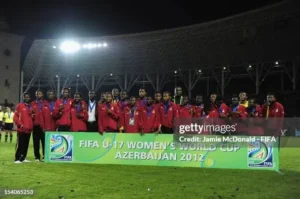
The 2012 tournament in Azerbaijan remains a landmark in the Black Maidens’ World Cup history.
Under Mas-Ud Didi Dramani, Ghana recovered from an opening defeat to Germany by recording victories over Uruguay and China to advance from the group stage.
Their progress continued in the quarter-finals, where Sherifatu Sumaila scored the decisive goal in a 1-0 win over Japan, sending Ghana into the last four.
The Black Maidens subsequently lost to France in the semi-finals, missing out on a place in the final. They responded impressively in the third-place play-off, defeating Germany to claim the bronze medal.
The achievement remains Ghana’s best finish at the FIFA U-17 Women’s World Cup and established the team among the competition’s notable performers.
2014: A quarter-final exit on penalties
Ghana carried their growing reputation into the 2014 edition in Costa Rica, with Evans Adotey taking charge of the team.
For the first time in their World Cup history, the Black Maidens finished top of their group. They opened with a 2-0 victory over Germany before beating North Korea 1-0 to secure their place in the quarter-finals.
A 2-1 defeat to Canada in their final group match did not prevent Ghana from progressing as group winners.
Their quarter-final encounter against Italy proved a much tighter contest, with neither side able to settle the tie in regulation time. The match went to a penalty shoot-out, where Italy prevailed to end Ghana’s campaign.
Although the Black Maidens fell short of another semi-final appearance, topping their group represented a significant achievement.
2016: North Korea ends Ghana’s run
Adotey retained his position for the 2016 tournament in Jordan, where Ghana again advanced beyond the group stage.
The campaign began with a heavy 5-0 defeat to Japan, but the Black Maidens recovered with victories over the United States and Paraguay, winning 2-1 and 1-0 respectively.
Those results secured a quarter-final place, setting up a meeting with North Korea.
Ghana’s hopes of reaching the semi-finals were dashed by a 2-1 defeat, marking their second consecutive quarter-final exit.
Nevertheless, the team had established a pattern of progressing from the group stage, reinforcing their standing as a competitive force at the youth level.
2018: Mukarama Abdulai leads Ghana’s golden run
The 2018 edition in Uruguay produced one of the most memorable individual performances in the history of the competition, with Mukarama Abdulai emerging as the tournament’s leading scorer.
Under head coach Evans Adotey’s successor, Bashir Hayford, Ghana delivered a flawless group-stage campaign, winning all three matches to collect nine points.
Mukarama scored a hat-trick in a 5-0 victory over Uruguay before finding the net again in a 3-1 win against Finland. She then scored twice in Ghana’s 2-0 triumph over New Zealand, completing a remarkable group-stage performance.
The Black Maidens entered the quarter-finals full of confidence but were held by Mexico in a contest that went into extra time and eventually a penalty shoot-out. Ghana lost the shoot-out, bringing their campaign to an end despite their impressive performances in the group stage.
Mukarama finished as the tournament’s top scorer, becoming the first African player to achieve the feat at the FIFA U-17 Women’s World Cup. Her exploits remain a major highlight of Ghana’s history at the competition.
The quarter-final defeat was particularly painful because Ghana had won every group match and appeared capable of making another deep run.
The years away from the global stage
Since their last appearance in 2018, the Black Maidens have endured a lengthy absence from the competition.
Ghana failed to qualify for the 2022 edition after losing to Morocco on penalties. The country subsequently faced disciplinary sanctions relating to age falsification, contributing to its absence from the following editions.
The prolonged gap has meant that a new generation of players will have to carry forward the legacy established by the teams of 2012, 2014, 2016 and 2018.
For Adarkwa and his squad, qualification for Morocco 2026 is therefore more than a return to competition. It is an opportunity to re-establish Ghana on the global stage and create a new chapter in the Black Maidens’ history.
Adarkwa faces a defining challenge in Morocco
Adarkwa secured Ghana’s qualification after a successful run through the African qualifiers, navigating ties against Togo, Liberia and Senegal to book the team’s place at the tournament.
Now, with Norway, Brazil and Canada standing between Ghana and a place in the knockout stage, the head coach faces the task of translating that qualification success into performances against international opposition.
The Black Maidens’ preparations in Morocco included friendly matches against China and Kenya. After losing 3-0 to China, Ghana responded with a 2-1 comeback victory over Kenya, with captain Sadiatu Wahab converting a penalty before Priscilla Mensah scored the winner.
The result offered encouragement ahead of the tournament, although the challenges awaiting Ghana in Group C will demand consistency, defensive discipline and clinical finishing.
Ghana’s Group C fixtures
Sunday, October 18: Ghana vs Norway — 18:00 GMT
Wednesday, October 21: Ghana vs Brazil — 18:00 GMT
Saturday, October 24: Ghana vs Canada — 15:00 GMT
All three matches will be played at the Mohammed VI Football Complex in Rabat.
Ghana’s record at the tournament provides both inspiration and expectation. The bronze medal of 2012 remains the high point, while the quarter-final runs of 2014, 2016 and 2018 demonstrate the team’s ability to advance beyond the group stage.
As the Black Maidens prepare to face Norway in their opening fixture, the immediate objective will be to start strongly and put themselves in a favourable position to progress.
After years away from the global stage, the 2026 tournament offers Ghana a chance to turn its proud history into a fresh achievement — and to remind the world that the Black Maidens remain a team to watch in women’s youth football.